Why Children Often Start Whispering Private Facts Loudly Before They Learn What Counts as Personal Information
Many parents recognize the moment instantly. A child leans in as though about to share a secret, then says something surprisingly loud about another person’s body, a family detail, a bathroom topic, a medical fact, or a private household event. The child clearly senses that the topic is different from ordinary conversation, yet still does not know how to handle it well.
Child development specialists generally note that children often start whispering private facts loudly before they truly understand what counts as personal information because awareness of secrecy usually develops earlier than judgment about privacy, audience, and social boundaries. In many homes, what looks like deliberate embarrassment is actually a child standing in the middle of an important developmental shift. This matters because adults can easily misread the behavior.
A child may seem rude, dramatic, or intentionally provocative when the deeper reality is usually more innocent and more interesting. Development guidance often suggests that children first learn that some information feels “special” or “not for everyone” long before they understand how volume, timing, setting, and other people’s dignity all fit into that idea. Over time, understanding this stage can help parents teach privacy more calmly and help children grow from clumsy secrecy into real discretion.
Children Often Notice That Some Topics Feel Different Before They Know Why
Young children are sharp observers of emotional tone. They often notice that adults react differently to certain subjects long before they understand the social logic behind that reaction. A child may hear adults lower their voice around medical updates, money, bodies, or family conflict. The child may not know the rules, but the child senses that this kind of information carries a different weight.
Child development experts generally explain that children often detect emotional categories before fully understanding social categories. In many families, this is why a child begins whispering certain facts. The child has picked up that something is “special” or “not ordinary,” but has not yet learned what makes information private in a mature way.
Whispering Is Often an Early Sign of Emerging Social Awareness
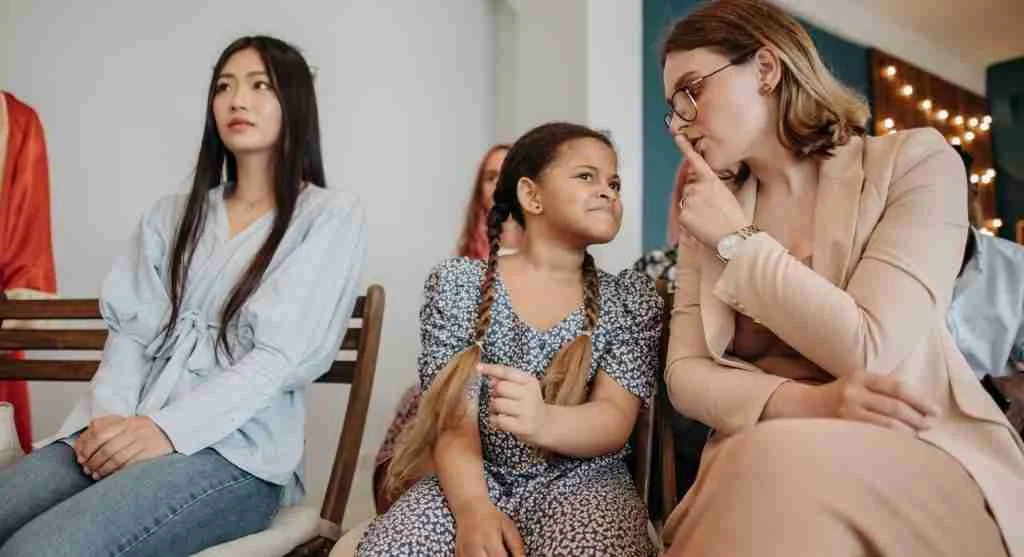
Parents sometimes hear a loud whisper and think only about the awkwardness of the moment. Yet the whisper itself can be developmentally meaningful. It often shows that the child is beginning to realize that not everything should be announced in a regular voice. That realization matters. It means the child is moving beyond pure blurting into a more complicated stage where communication starts to include audience and sensitivity, even if the skill is still very rough.
Family communication specialists generally note that children often show new social awareness in clumsy early forms. In many homes, loud whispering is one of those forms. It is not yet skilled privacy, but it is often a step away from total innocence about what gets said and how.
Children Often Understand “Secret” Before They Understand “Private”
One reason these moments happen so often is that secrecy and privacy are not the same thing, but children tend to learn them in uneven ways. A child may understand that a secret is something unusual, exciting, or not meant to be shouted. That does not mean the child yet understands privacy as respect for someone else’s boundaries, dignity, or choice about who gets to know something.
Development specialists generally explain that children often begin with a simpler idea: some information is hidden or special. The richer idea — that some information belongs to a person and should be handled with care — usually takes longer. In many families, loud whispering reflects that gap between early secrecy awareness and more mature privacy understanding.
Children Often Focus on the Information Itself, Not the Audience Around Them
Adults tend to scan a room automatically. They notice who is nearby, who can hear, and whether the setting is appropriate. Children often do not manage all of that at once. They may focus entirely on the fact they want to communicate and only vaguely register the people around them. The child is thinking, “I need to tell you this now,” not “Who else might hear this?”
Child behavior experts generally note that audience awareness develops gradually. In many families, a child’s “private” comment becomes public because the child is still learning how to hold both message and audience in mind at the same time.
Some Topics Feel Especially Urgent Because Children Are Still Organizing Them Internally
Children often speak loudly about private topics not only because they lack filters, but also because those topics may feel mentally urgent. Bodies, bathroom questions, illness, pregnancy, money, and family conflict can all feel unusually important or confusing to children. When something feels emotionally charged, the child may want immediate clarity or connection around it, even if the timing is socially poor.
Development guidance often suggests that children speak impulsively about the very things they are still trying hardest to understand. In many homes, the loud whisper reflects not only poor privacy skill but also active internal processing. The child is still working out what the information means.
Children Often Treat Whispering Like a Complete Privacy Solution
Adults know that true privacy involves more than lowering volume. It includes choosing the right time, the right place, and the right person. Children often do not yet divide the skill that way. They may believe that if they whisper, the privacy job is done. The child has found one visible strategy and assumes it covers the whole social problem.
Child development specialists generally explain that children often master one piece of a social rule before understanding the larger system around it. In many homes, whispering becomes that first piece. The child knows the topic should be handled differently, but not yet how many layers that difference includes.
This Stage Often Appears Around Body Awareness, Family Details, and Social Curiosity
Not every topic becomes a loud whisper. The pattern is often strongest around areas where children are already developing curiosity and partial awareness. Comments about appearance, age, illness, body differences, money, underwear, bathroom habits, pregnancy, or household tension often show up here because children sense these areas carry stronger emotional rules than everyday topics do.
Family relationship specialists generally note that the content of these whispers often reflects the places where children are learning social boundaries most actively. In many homes, the awkward subject itself offers clues about what the child is trying to understand developmentally.
Parents Often Help Most by Teaching Privacy as Respect, Not Only Silence
When adults respond only with “Don’t say that” or “Be quiet,” children may learn fear or shame faster than they learn wisdom. A more useful lesson is often that private information is connected to people’s comfort, dignity, and choice. The goal is not only lower volume. The goal is understanding why certain facts are handled gently and with more care.
Parenting specialists generally note that children learn privacy better when adults connect it to respect instead of only to rule-breaking. In many families, children grow faster once they hear that some things belong to a person and are not for public discussion without permission.

Children Usually Need Repetition Before Discretion Becomes Smooth
Privacy is not one lesson learned in a single awkward store trip or family gathering. Children often need many small experiences to understand that some information should wait, some information belongs only in private places, and some information is not theirs to share. At first, they may still whisper too loudly, choose the wrong moment, or confuse interesting facts with shareable facts. That does not mean nothing is being learned.
Development specialists generally explain that discretion grows through repeated correction, modeling, and experience. In many homes, children move slowly from blurting to whispering, then from whispering poorly to choosing better moments and better boundaries.
This Stage Often Softens as Perspective-Taking Improves
One major piece of privacy skill is the ability to imagine how another person might feel if certain information is shared. That kind of perspective-taking deepens gradually. As children become better able to picture embarrassment, discomfort, or personal boundaries from someone else’s point of view, their handling of private information often becomes more thoughtful too.
Child development experts generally note that true discretion depends on both language control and social empathy. In many families, loud whispering begins to fade as children become more capable of seeing beyond the immediate urge to tell and into the effect their words may have on others.
Why Children Often Start Whispering Private Facts Loudly
Children often start whispering private facts loudly before they learn what counts as personal information because awareness of secrecy tends to arrive before mature judgment about privacy, audience, and respect. The child senses that some topics are different, but does not yet know how to handle them well. That is why the behavior can look partly socially aware and partly socially off at the same time.
In many families, understanding this stage changes the way adults respond. What first feels like public embarrassment often includes real development underneath it. Over time, with calm guidance and repeated teaching, children usually grow from loud whispering into a more thoughtful understanding of what should be said, where, and to whom.
FAQ
Why does my child whisper private things so loudly?
Often because the child has begun sensing that the topic is different but has not yet learned how privacy, audience, and volume all work together.
Does this mean my child is trying to embarrass people?
Usually not. Most children in this stage are showing developing social awareness in a clumsy form rather than trying to be hurtful.
What is the difference between secrecy and privacy for children?
Secrecy is often understood first as something hidden or special, while privacy is the deeper idea that some information should be handled respectfully and with care.
Will this usually improve over time?
Often yes. As perspective-taking and social judgment grow, many children become much better at choosing what to say, when to say it, and how privately to say it.
Internal Linking Suggestions
Link this article to posts about social development in children, teaching boundaries, family communication skills, emotional growth, and helping children navigate public behavior more thoughtfully.
Key Takeaway
Children often start whispering private facts loudly before they fully understand privacy because social awareness of “special information” usually develops before mature judgment about audience, respect, and timing. Many children first learn that some topics feel different before learning what personal information really is. Families often help most when they teach privacy as respect rather than only as silence. Over time, this stage can become part of stronger social judgment, empathy, and better communication.